Ever wondered how Google tells you instantly that a username is already taken? Or how Chrome knows a URL is malicious before you even click it?
Checking a database with billions of records for every single keystroke would be a latency nightmare. Instead, these systems use a compact probabilistic structure called a Bloom Filter, one that can definitively tell you something is absent, but can only say something might be present. Today I’m walking through how I built one from scratch in Java, from raw logic to a production-ready generic class, including the math, the non-obvious gotchas, and when you’d actually use this over Guava’s built-in.
1. What is a Bloom Filter?
To understand why this structure exists, think about the analogy first,then we’ll look at the mechanism.
The Kirana Store Analogy
Imagine you’re managing a massive Kirana store godown (warehouse) during the peak Diwali rush. You have thousands of items stacked in piles, and digging through them to check if you stock a specific brand is a total nightmare.
So you use a “Jugaad” shortcut: a small index card at the front counter. Every time you stock a new item, you don’t write its name. Instead, you follow a code and put three specific colored stamps on the card. For “Amul Ghee,” the code might be Red, Green, and Blue.
This gives you two possible outcomes when a customer asks for something:
The “Pakka No” (Definite No): A customer asks for a rare brand of tea. You check the card: the Red stamp is missing. You know for a fact it’s not there, without even walking to the back. “Nahi hai, zepto karlo.” You just saved 10 minutes of pointless searching.
The “Shaayad” (Maybe): Another customer asks for “Saffola Oil.” All three stamps are present. It might be in the back. But you still have to go check, because the Red, Green, and Blue stamps might have been left behind by three different items you stocked earlier (say, Parle-G set Red, Papad set Green, and Dettol set Blue). That’s a false positive. The card lied.
A Bloom Filter is exactly this card, implemented as a bit array with multiple hash functions.
2. How It Works: The Mechanism
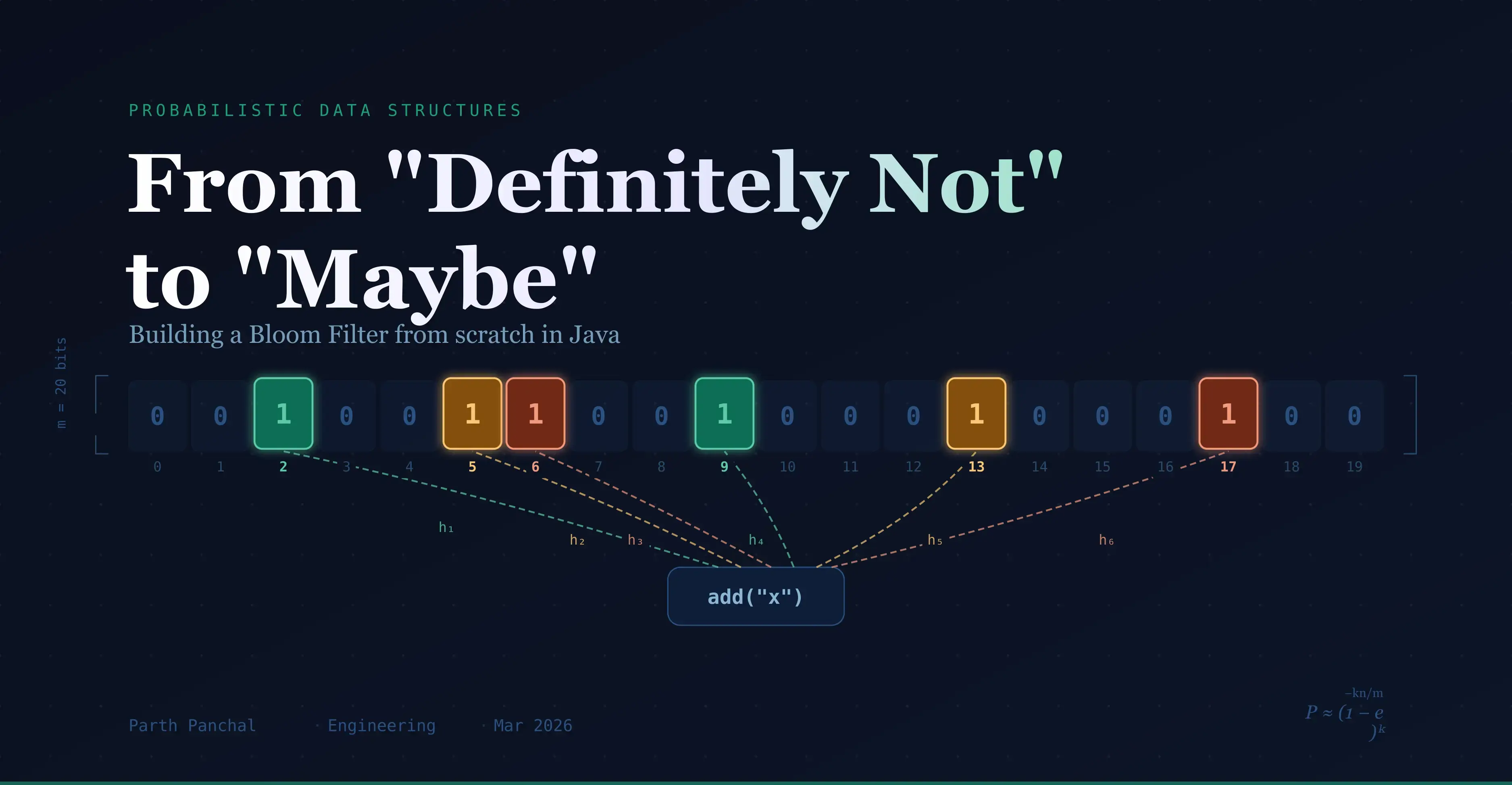
The structure is a bit array of size $m$, initialized to all zeros. Adding an item means running it through $k$ hash functions, each producing an index, then flipping those $k$ bits to 1. Checking membership means running through the same $k$ functions and verifying all those bits are still 1.
The Asymmetry That Matters
- ABSENT = CERTAIN: If even one of the $k$ bits is
0, the item was never added. It is physically impossible for it to be present, because adding it would have set that bit. - PRESENT = MAYBE: All $k$ bits are
1, but those bits might have been flipped by a combination of other items. That’s a false positive.
The diagram below shows both scenarios. Panel A shows a true add: “Amul Ghee” sets bits 2, 6, and 11 via three hash functions. Panel B shows the false positive trap: three different items each happen to set one of those same bits. A query for “Saffola Oil” checks positions 2, 6, and 11, finds all three at 1, and incorrectly returns “maybe present.”
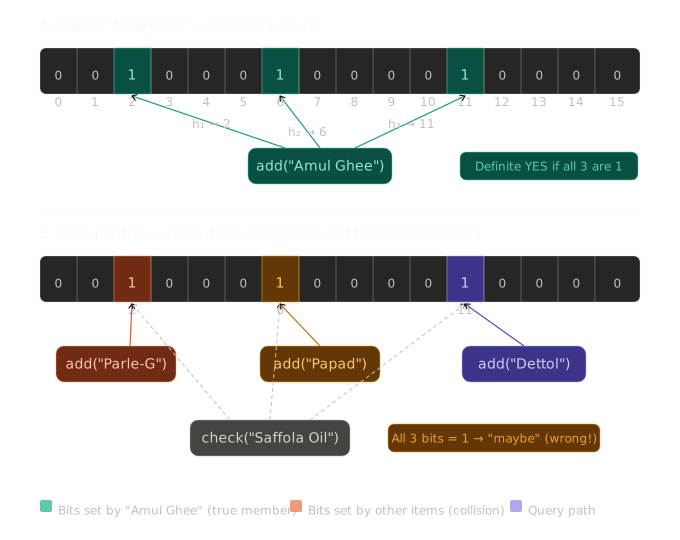
This asymmetry is the core property, and the reason Bloom Filters are used as a fast pre-filter before hitting a slower, accurate store (like a database or disk).
False Positive Probability
The probability of a false positive after inserting $n$ items into a filter of size $m$ with $k$ hash functions is:
$$P \approx \left(1 - e^{-kn/m}\right)^k$$
This is what we’re optimizing when we choose $m$ and $k$. We want $P$ to stay below our acceptable error rate.
3. The Math of Optimization
We don’t pick $m$ and $k$ by guessing. Given an expected item count $n$ and a target false positive rate $p$, the optimal values are:
Optimal bit array size ($m$): $$m = -\frac{n \ln p}{(\ln 2)^2}$$
Optimal number of hash functions ($k$): $$k = \frac{m}{n} \ln 2$$
Worked Example
Say you’re building a “have we seen this URL before?” cache for 1,000 items with a 1% false positive rate:
- $m = -\frac{1000 \times \ln(0.01)}{(\ln 2)^2} \approx 9{,}586$ bits, roughly 1.2 KB
- $k = \frac{9586}{1000} \times \ln 2 \approx 7$ hash functions
Compare that to storing 1,000 strings (averaging ~40 bytes each) = ~40 KB. The Bloom Filter uses 33× less memory, with only a 1% chance of a false positive.
4. The Hashing Strategy
We don’t actually implement $k$ separate, complex hash algorithms. Instead, we use a technique from Kirsch & Mitzenmacher (2008), often called hash function simulation, which generates $k$ independent-looking indices from just two base hashes:
- Primary hash ($h_1$):
value.hashCode() - Secondary hash ($h_2$):
Integer.rotateRight(h1, 16), which scrambles the bits efficiently - Derived indices: For each $i$ from $0$ to $k-1$:
$$H_i(x) = (h_1 + i \times h_2) \pmod{m}$$
This is distinct from double hashing in the open-addressing hash table sense. Here we’re simulating independent hash functions without the cost of actually computing them. The paper proves this approach introduces negligible degradation in false positive rates.
5. Implementation: Step-by-Step
Core Data Structures
java.util.BitSet: our storage layer; far more memory-efficient than aboolean[]since it packs 64 bits perlong.int m— total number of bits in the filter.int k— number of hash indices we compute per item.
Step 1 — The Non-Generic Version
Start simple: a filter that only handles String values. This isolates the hashing logic before we generalize.
public class BloomFilter {
    private final BitSet bitSet;
    private final int m, k;

    public BloomFilter(int m, int k) {
        this.bitSet = new BitSet(m);
        this.m = m;
        this.k = k;
    }

    public void add(String value) {
        int h1 = value.hashCode();
        int h2 = Integer.rotateRight(h1, 16);

        for (int i = 0; i < k; i++) {
            int combinedHash = h1 + (i * h2);
            // The & 0x7fffffff mask strips the sign bit (see callout below)
            int index = (combinedHash & 0x7fffffff) % m;
            bitSet.set(index);
        }
    }

    public boolean mightContain(String value) {
        int h1 = value.hashCode();
        int h2 = Integer.rotateRight(h1, 16);

        for (int i = 0; i < k; i++) {
            int index = ((h1 + (i * h2)) & 0x7fffffff) % m;
            if (!bitSet.get(index)) return false; // Definite NO
        }
        return true; // Maybe
    }
}
The sign-bit trap: In Java,
Math.abs(Integer.MIN_VALUE)returnsInteger.MIN_VALUE; it stays negative because there’s no positive counterpart in 32-bit signed integers. Using the raw value with% mwould produce a negative index and throw anArrayIndexOutOfBoundsException. The bitwise AND& 0x7fffffffclears only the sign bit, forcing the value positive without any branch or overflow risk.
Tracing a Concrete Add
Let’s trace add("hello") on a filter with m=16, k=3:
h1 = "hello".hashCode()        = 99162322
h2 = Integer.rotateRight(h1,16) = 1513677412  (approximate)

i=0: index = (99162322 + 0) & 0x7fffffff % 16 = 2
i=1: index = (99162322 + 1513677412) & 0x7fffffff % 16 = 6
i=2: index = (99162322 + 3027354824) & 0x7fffffff % 16 = 11

Bits set: [2, 6, 11]
A subsequent mightContain("hello") recomputes the same three indices and confirms bits 2, 6, and 11 are all 1. A word that hashes to indices [2, 5, 11] would return false immediately at bit 5, a definite NO.
6. Refactoring for Generics
The only real change is the type parameter — the hashing logic is identical since we’re still calling .hashCode(), which every Java object has via Object.
public class BloomFilter<T> {
    private final BitSet bitSet;
    private final int m, k;

    /**
     * @param n  Expected number of items to insert
     * @param p  Desired false positive probability (e.g. 0.01 for 1%)
     */
    public BloomFilter(int n, double p) {
        if (n <= 0) throw new IllegalArgumentException("n must be positive");
        if (p <= 0 || p >= 1) throw new IllegalArgumentException("p must be in (0, 1)");

        this.m = (int) Math.ceil(-n * Math.log(p) / Math.pow(Math.log(2), 2));
        this.k = (int) Math.ceil((m / (double) n) * Math.log(2));
        this.bitSet = new BitSet(m);
    }

    public void add(T value) {
        if (value == null) throw new IllegalArgumentException("Null values are not supported");

        int h1 = value.hashCode();
        int h2 = Integer.rotateRight(h1, 16);

        for (int i = 0; i < k; i++) {
            int index = ((h1 + (i * h2)) & 0x7fffffff) % m;
            bitSet.set(index);
        }
    }

    public boolean mightContain(T value) {
        if (value == null) return false;

        int h1 = value.hashCode();
        int h2 = Integer.rotateRight(h1, 16);

        for (int i = 0; i < k; i++) {
            int index = ((h1 + (i * h2)) & 0x7fffffff) % m;
            if (!bitSet.get(index)) return false;
        }
        return true;
    }

    /** Approximate current false positive rate based on items inserted so far. */
    public double currentFalsePositiveRate(int itemsInserted) {
        return Math.pow(1 - Math.exp(-(double) k * itemsInserted / m), k);
    }

    public int getBitArraySize() { return m; }
    public int getHashCount()    { return k; }
}
Key change from the non-generic version: The constructor now takes n and p. The user declares their intent, and the filter derives its own optimal m and k. You no longer have to manually calculate these and pass them in correctly.
Usage:
BloomFilter<String> urlCache = new BloomFilter<>(1_000, 0.01);
urlCache.add("https://malicious-site.com");

if (urlCache.mightContain("https://malicious-site.com")) {
    // Hit the real DB/blocklist to confirm
}
7. Limitations to Know Before You Ship
A Bloom Filter is powerful, but it has hard constraints that make it unsuitable in some situations:
| Constraint | Detail |
|---|---|
| No deletion | You can’t remove an item. Clearing a bit might unset a bit shared by another item, corrupting the filter. (Counting Bloom Filters solve this at the cost of more memory.) |
| No value retrieval | The filter only stores membership signals, not the items themselves. You can’t ask “what items are in this filter?” |
| False positive rate grows | If you insert more items than the n you planned for, $P$ climbs above your target. The filter silently degrades. Use currentFalsePositiveRate() to monitor this in production. |
| Hash quality matters | Java’s default hashCode() is not a cryptographic or uniformly distributed hash. For high-sensitivity use cases, consider wrapping objects with a stronger hash (e.g. MurmurHash via a library). |
8. Roll Your Own vs. Use Guava
Google’s Guava library ships a production-hardened com.google.common.hash.BloomFilter. It uses a better hash function (Murmur3), handles serialization, and is well-tested at scale.
Use Guava when:
- You’re building something production-critical and Guava is already a dependency.
- You need serialization / persistence of the filter state.
- You want to avoid rolling your own hash quality decisions.
Roll your own when:
- You want to understand the structure deeply (exactly what you’re doing here).
- You have no JVM dependencies available (embedded systems, Android with strict APK size limits).
- You need a custom eviction or counting variant that Guava doesn’t support.
For most production Java services, Guava’s BloomFilter is the right call. The custom implementation here is the foundation for understanding — and extending — it.
9. Performance and Complexity
| Operation | Time Complexity | Space |
|---|---|---|
add(value) | $O(k)$ | $O(1)$ additional, bits are set in the existing array |
mightContain(value) | $O(k)$ | $O(1)$ additional, no allocation |
| Construction | $O(m)$ | $O(m)$ bits: the bit array itself |
$k$ is typically a small constant (6–10 for common configurations), so both add and mightContain are effectively $O(1)$ in practice. The memory footprint is $m$ bits (for the 1,000-item / 1% error example above, that’s under 1.2 KB) regardless of how large the inserted strings are.
References
Bloom, B. H. (1970). Space/Time Trade-offs in Hash Coding with Allowable Errors. Communications of the ACM, 13(7), 422–426. The original paper introducing the structure.
Kirsch, A., & Mitzenmacher, M. (2008). Less Hashing, Same Performance: Building a Better Bloom Filter. Random Structures & Algorithms, 33(2), 187–218. The source for the two-hash simulation technique used here.
Google Guava
BloomFiltersource: github.com/google/guava, worth reading after you’ve built your own.